
Açıklama
The difference
Long Lasting Effectiveness
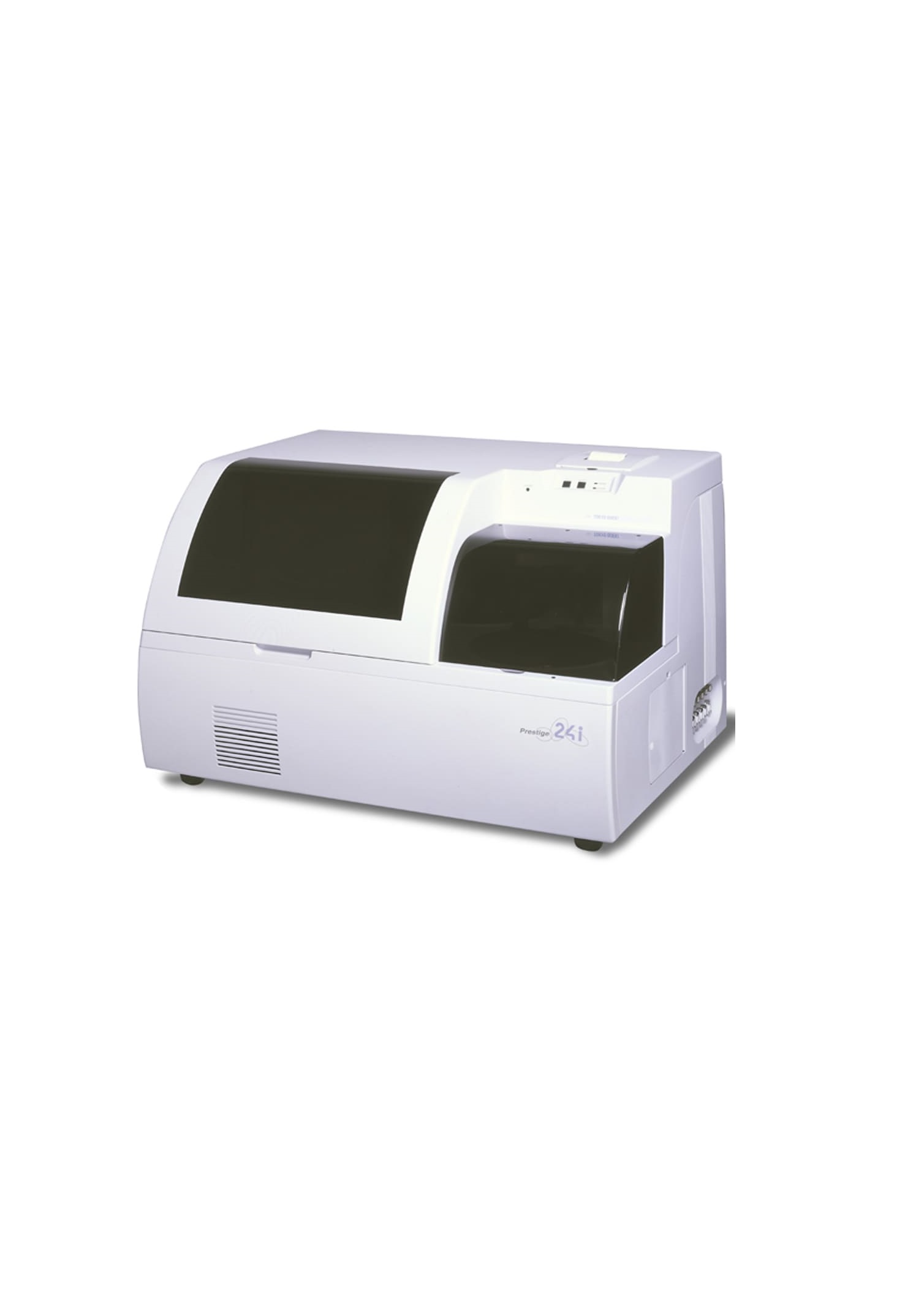
| Manufacturer: | Tokyo Boeki |
| Private Labeled to Market: | TM-MGC240, SL-SIRRUS |
| Series: | Prestige |
| CLIA Complexity: | Moderate |
| Sample Types: | CSF, Dialysate, Plasma, Urine, Serum |
| Number of Assays: | 68 |
| Maximum Throughput: | 240 tests/hour |
| Sample Size Min: | 3 μL |
| Direct Sample (STAT): | Yes |
| Auto Sample Handling: | No |
| Sample Input Type: |
Sample Cups
Sample Tubes
|
| Reagent Type: | Liquid |
| Reagent System: | Open |
| Reagent Capacity: | 48 |
| On-Board Refrigeration: | Yes |
| Configuration: | Bench Top |
| Height: | 52 cm (20 in) |
| Width: | 80 cm (31 in) |
| Depth: | 64 cm (25 in) |
| Weight: | 80 kg (176 lb) |
| Water Requirement: | Yes |
| Water OnBoard Supply: | No |
| Water Consumption: | 3.5 (L/hour) |
| Power Supply: | 110V-220V |
| Point Of Care: | No |
The knowledge
Everything that needs to be said
- The device is multiple random access (Selective Random Access). It can be programmed to do only the required tests from each sample in its configuration.
- After the device samples are programmed and loaded with multiple random selections, it works fully automatically without requiring any intervention from the operator until the result is received in the form of a patient report.
- The device routinely measures 39 different parameters simultaneously from a sample.
- The device can work with serum, plasma, urine and Bos samples, requiring no dilution or other pre-treatment before the samples are introduced into the device.
- The operating procedure of the device progresses patient to patient, after completing all the tests requested from one sample, it moves to the next sample.
- While the device analysis continues, the patient reports whose tests have been completed are taken from the printer.
- The device has an emergency operation progam. Urgent samples are loaded into the device at any time.
- Regardless of the test used, the device can run at least 240 tests per hour (except ISE). It runs 400 tests/hour including ISE.
- A minimum of 55 samples can be loaded into the instrument at a time.
The sample volume for each test is 3-30 µl. - The autoanalyzer has two separate reagents and a sample probe, and the probes have a liquid level detector.
- While the device is running the programmed samples, the operator then enters the programs for the new samples.
- Optionally, the information of lipemic and hemolyzed serums can be entered into the patient report.
- 36 parameters can also be loaded into the device with double reagents.
The reagent volume is selected at the desired value between 20-350.
Bichromatic reading is available in the system. - There are 12 filters in the device between 340-800 nm and the wavelength width is 0-2.5 OD.
- Analysis groups (profiles) specific to certain diseases are defined in the device.
- It has a minimum of 60 test programs, data collection for up to 10,000 samples and reaction curves for up to 2500 tests.
- Measurements are directly in the optical cuvette and every 15 seconds.
- The reaction cuvettes are mixed with air pressure and cleaned with a minimum 12-stage washing program, the cuvettes are reused, the cleanliness is measured optically, and the unsuitable cuvette is automatically disqualified.
- The probes are washed internally and externally to prevent contamination between tests in the instrument system.
- There is a cooling system on the device that can keep the reagents at 10+-2 C.
- The reaction volume is programmable 200-400 µl total (for dual reagent tests).
- It is possible to display daily and cumulative, quality control values graphically and to get SD and CV % from the device.
- The device has barcode reading for serum tubes and reagents.
- Ready-made reagents with barcodes are placed in the device without any pre-processing and are automatically recognized by the device.
- The device can be connected to the laboratory automation system and patient results are automatically sent to the system.







Henüz değerlendirme yapılmadı.